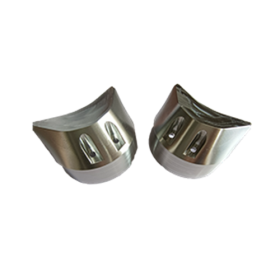
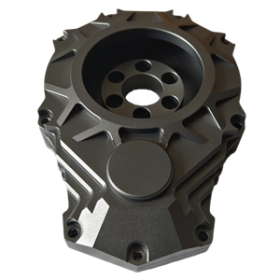
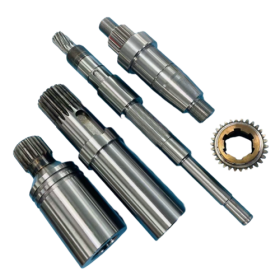
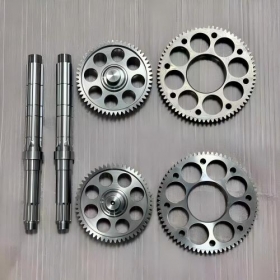
Industrial machinery components serve as the core foundation of all mechanical equipment. The quality, precision and durability of these spare parts directly determine the overall performance, operational stability and service life of industrial machinery. With a wide range of product categories, each customized component undertakes independent and critical mechanical functions to ensure equipment runs in line with strict industrial standards.
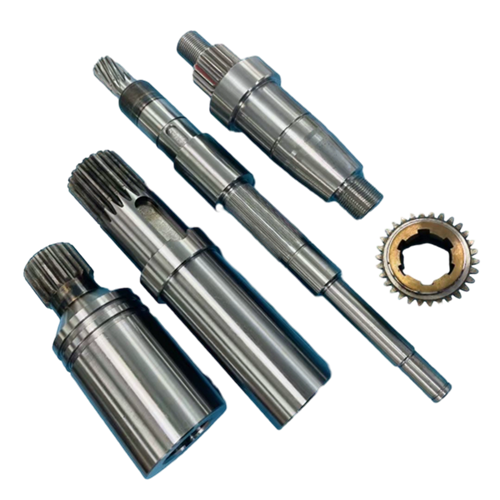
The transmission shaft is a mechanical part that transfers spinning power between different sections of a vehicle or machine. Cylindrical rods are usually crafted to handle twisting force while transmitting torque.
| Shaft Type | Typical Use | Key Machining Requirements |
|---|---|---|
| Motor shaft | Electric motor rotor support | Concentricity 0.005mm TIR, keyway parallel to axis |
| Gear shaft (integral gear) | Transmission, reducer | Gear seat concentricity, shoulder perpendicularity |
| Linear shaft / guide rod | Linear bearings, actuators | Surface hardness HRC 58–62, straightness 0.05mm per meter |
| Idler shaft | Chain/belt tensioner | Bearing journal tolerance h6 or j6 |
| Drive shaft (long) | Power transmission, PTO | Straightness 0.10mm per meter, balanced |
| Worm shaft | Worm gear reducer | Thread form accuracy, flank finish Ra 0.8μm |
| Crank shaft (single throw) | Reciprocating mechanism | Pin offset accuracy ±0.01mm, surface finish critical |
The most commonly used materials include:
carbon steel
Carbon steel is a commonly used material for transmission shafts, with high strength and good processability. Common carbon steel materials include 35, 40, 45 steel or 40Cr steel. After quenching and tempering treatment, the hardness ranges of these materials are HB190~HB250 and HB240~HB290, respectively.
stainless steel
Stainless steel transmission shafts are commonly used in environments that require corrosion resistance. Austenitic stainless steel is a commonly used material, and its sealing section requires hardening treatment, such as hard chromium plating, nitriding, welding, or ceramic spraying, to improve its hardness and corrosion resistance.
Special alloy
In certain special applications, special alloys such as nickel based alloys are also used for transmission shafts to meet higher requirements for corrosion resistance and high temperature resistance.
Material selection criteria
The material selection of the transmission shaft is mainly based on its usage environment and specific requirements:

Dongguan Bomei Precision Machining Co., Ltd
Address: 101, No68, Ditangshan Road 2,Dalingshan Town, Dongguan, Guangdong, China
Contact person: Evan Xiao Evan Xiao