
Gang Lathe vs Swiss Lathe: Key Differences & Machining Applications | Bomei Precision Machining
In precision turning machining, Gang Lathe and Swiss Lathe are two widely used equipment types, each with unique structural advantages and application scenarios. For manufacturers seeking high-precision, high-efficiency machining solutions—especially for small-diameter, complex cylindrical parts—understanding the core differences between Gang Lathe and Swiss Lathe is crucial to selecting the optimal machining equipment, reducing production costs, and ensuring part quality.
What Are Gang Lathe & Swiss Lathe?
1. Gang Lathe (Gang-Type Lathe)
2. Swiss Lathe (Swiss-Type Lathe)
Swiss Lathe is equipped with a guide bushing that supports the workpiece near the cutting area, minimizing deflection and vibration during machining—this is the key to ensuring high precision for slender parts. It is widely used in high-precision industries such as medical, aerospace, and microelectronics, with the advantages of ultra-high precision, high efficiency, and good repeatability.
Key Differences Between Gang Lathe & Swiss Lathe
1. Structural Design & Working Principle
- Gang Lathe: Fixed workpiece + moving gang tool turret. The tool turret integrates multiple tools, which can complete multiple machining operations by switching tools, without the need for workpiece re-clamping. The chuck clamps the workpiece at one end, and the tool moves along the X/Z axes to process the workpiece.
- Swiss Lathe: Moving workpiece + fixed tool post. The workpiece is clamped by a collet and moves along the Z axis through the guide bushing, while the fixed tools cut the workpiece. The guide bushing provides support for the workpiece, reducing deflection caused by cutting force—critical for slender parts (length-diameter ratio >10:1).
2. Machining Precision & Tolerance Control
- Gang Lathe: Suitable for medium-precision machining, with dimensional tolerance up to ±0.005 mm and coaxiality up to 0.008 mm. Due to the lack of guide bushing support, it is difficult to control deflection for slender parts, leading to precision degradation.
- Swiss Lathe: Specialized in ultra-high-precision machining, with dimensional tolerance up to ±0.001 mm and coaxiality up to 0.002 mm. The guide bushing design ensures that the cutting area is close to the support point, minimizing workpiece deformation and vibration, and ensuring stable precision for batch production.
3. Applicable Part Specifications & Geometries
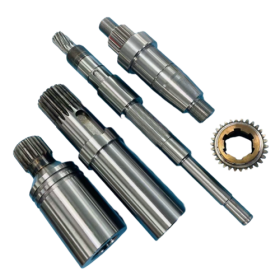
- Gang Lathe: Suitable for parts with diameter 5-50 mm, length-diameter ratio ≤10:1. Ideal for regular cylindrical parts, such as shafts, bushings, and simple stepped parts. Not suitable for slender parts or parts with complex internal features.
- Swiss Lathe: Suitable for parts with diameter 0.1-32 mm, length-diameter ratio up to 30:1. Perfect for slender parts, micro-parts, and parts with complex features (e.g., multiple steps, grooves, holes, and threads), such as medical needles, aerospace fasteners, and micro-motor shafts.
4. Machining Efficiency
- Gang Lathe: High efficiency for small-batch production of simple parts. The gang tool turret allows quick tool switching, reducing setup time. However, for complex parts, multiple tool changes are required, which may affect efficiency.
- Swiss Lathe: High efficiency for mass production of small, complex parts. It supports simultaneous machining (e.g., main tool post turning, sub tool post drilling), and the guide bushing design allows high cutting speed without affecting precision. The automation degree is high, reducing manual intervention and improving production efficiency.
5. Equipment Cost & Operating Requirements
- Gang Lathe: Lower equipment investment (about 1/3-1/2 of Swiss Lathe). The operation is relatively simple, requiring general CNC operators, and the maintenance cost is low. Suitable for small and medium-sized manufacturers with limited budgets.
- Swiss Lathe: Higher equipment investment, due to its complex structure (guide bushing, dual tool posts, and high-precision spindle). It requires professional operators with rich experience in Swiss Lathe operation and programming, and the maintenance cost is relatively high. Suitable for manufacturers pursuing high precision and mass production of small parts.
6. Surface Finish
- Gang Lathe: Surface finish Ra ≤0.8 μm for general materials (aluminum alloy, carbon steel), which meets the requirements of most general industrial parts.
- Swiss Lathe: Surface finish Ra ≤0.2 μm, thanks to the stable cutting environment (minimal vibration and deformation). It is suitable for parts with high surface quality requirements, such as medical devices and precision instruments.
Bomei’s Gang Lathe & Swiss Lathe Machining Service
Bomei Precision Machining, a professional precision turning manufacturer, is equipped with advanced Gang Lathe and Swiss Lathe equipment, providing customized machining services for industries such as automation, automotive, medical, and aerospace.
Whether you need Gang Lathe machining for regular parts, or Swiss Lathe machining for high-precision slender parts, Bomei Precision Machining is your reliable partner. Contact us today to share your part drawings and requirements, and let our professional team provide you with a tailored precision turning solution.


 Evan Xiao